
Email Marketing vs SMS Marketing: Key Differences
Email marketing and SMS marketing both help businesses reach customers, but they serve different purposes. Discover the key differences in cost, engagement, content, automation, personalization, and use cases to choose the right marketing channel—or combine both for a stronger strategy.
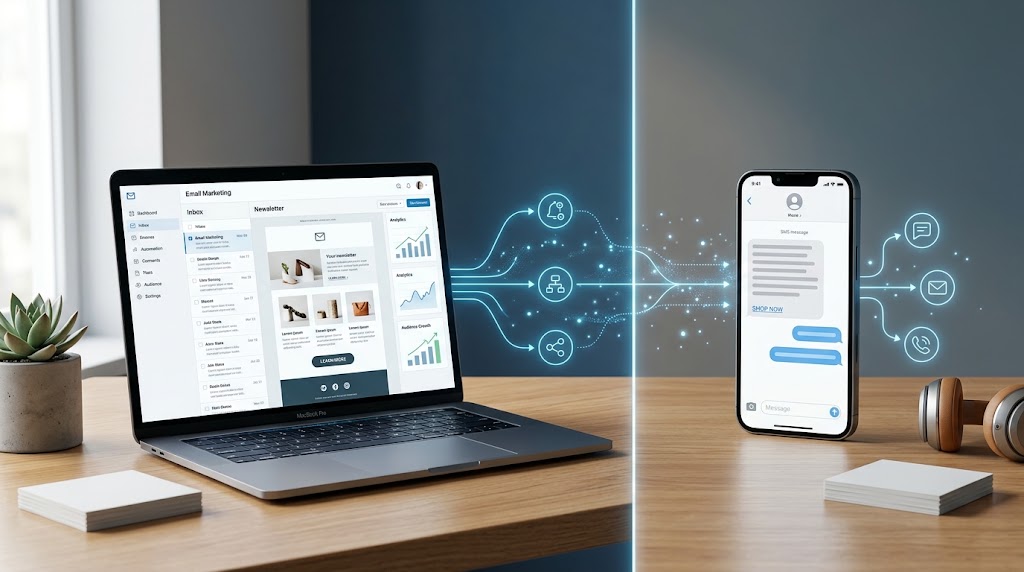
Email marketing and SMS marketing are two of the most effective ways for businesses to communicate with customers directly. Both channels can promote products, nurture leads, increase sales, and keep customers engaged. However, email marketing vs SMS marketing is not really a question of which channel is universally better. The more important question is which channel is better suited to a specific message, audience, and marketing goal.
Email gives businesses room for detailed content, visuals, newsletters, educational campaigns, and long-term customer nurturing. SMS marketing, on the other hand, is built around short, timely, and action-oriented messages that can reach customers directly on their mobile phones.
For businesses building a modern email marketing strategy, understanding the differences between email and SMS can help improve campaign performance and prevent customers from being overwhelmed by irrelevant messages.
In this guide, we'll compare email marketing vs SMS marketing based on reach, engagement, cost, content, personalization, automation, use cases, compliance, and overall marketing value.
What Is Email Marketing?
Email marketing is the practice of sending promotional, educational, transactional, or relationship-based messages to customers and subscribers through email.
Businesses use email marketing for:
- Newsletters
- Product announcements
- Promotional campaigns
- Welcome emails
- Abandoned cart campaigns
- Educational content
- Customer onboarding
- Product recommendations
- Seasonal promotions
- Lead nurturing
Email is particularly useful when a business needs enough space to explain an idea, showcase multiple products, tell a story, or guide customers toward a purchase.
A modern email marketing platform can also provide segmentation, automation, analytics, templates, audience management, and campaign scheduling. For example, businesses can use email marketing software to organize campaigns and manage subscribers from one place.
What Is SMS Marketing?
SMS marketing uses text messages to communicate promotional or informational messages directly to customers' mobile phones.
Because SMS messages are short, SMS marketing is usually most effective when the information is simple, timely, and action-oriented.
Common SMS marketing examples include:
- Flash sale alerts
- Limited-time discounts
- Appointment reminders
- Back-in-stock notifications
- Order updates
- Event reminders
- Abandoned cart reminders
- Time-sensitive offers
- Delivery notifications
For example, a clothing store might send:
"48 hours only: Get 20% off our new collection. Shop now."
The message is short, clear, and creates urgency.
Email Marketing vs SMS Marketing: Key Differences
Although both channels are part of digital marketing, they work differently.
FactorEmail MarketingSMS MarketingMessage lengthLong and flexibleShort and conciseBest forEducation, newsletters, storytellingUrgent offers and remindersContentText, images, buttons, videos, designsPrimarily short text and linksSpeedFast, but often checked laterHighly immediateCostGenerally lower per message at scaleOften charged per messagePersonalizationHighly advancedStrong but more limitedAutomationExtensiveStrong for triggers and alertsAudienceEmail subscribersMobile subscribersFrequency toleranceUsually higherUsually lowerIdeal customer journey stageAwareness, consideration, retentionUrgency, conversion, retentionThe biggest distinction is simple: email is better for depth, while SMS is better for immediacy.
Current industry comparisons similarly describe email as a stronger channel for detailed content and SMS as a stronger channel for time-sensitive communication.
1. Email Offers More Space for Content
One of the biggest advantages of email marketing is the amount of space available.
An email campaign can include:
- Product images
- Multiple products
- Promotional banners
- Educational information
- Customer reviews
- Videos
- Multiple calls to action
- Social media links
- Detailed explanations
This makes email particularly useful for brands that need to communicate more than one idea.
For example, an ecommerce business launching a new collection could send an email containing product images, descriptions, prices, benefits, and links to different product categories.
SMS does not provide the same amount of creative space. A text message needs to communicate its primary point quickly.
That's why businesses should avoid trying to turn SMS into a miniature email.
2. SMS Marketing Creates More Urgency
SMS marketing is particularly effective when timing matters.
Imagine a customer receives these two messages:
Email:
"Discover our new summer collection, including our latest products, seasonal offers, and customer favorites."
SMS:
"Sale ends tonight. Get 25% off before midnight."
The email provides information. The SMS creates urgency.
This makes SMS useful for flash sales, limited-time offers, appointment reminders, event notifications, and other situations where customers need to act quickly.
Research and industry comparisons consistently identify immediacy as one of SMS marketing's major advantages.
3. Email Marketing Is Usually Better for Long-Term Nurturing
Email is particularly valuable when the goal isn't an immediate purchase.
A business can create an automated email sequence that educates a new subscriber over several days or weeks.
For example:
Day 1: Welcome email
Day 3: Educational content
Day 5: Product benefits
Day 7: Customer stories
Day 10: Special offer
This type of sequence gradually moves prospects toward a purchase.
With an email automation platform, businesses can automate these customer journeys instead of manually sending every message.
Email therefore works especially well for lead nurturing, customer education, newsletters, and relationship building.
4. SMS Is Better for Short, Time-Sensitive Messages
SMS works best when customers don't need a long explanation.
For example:
- "Your appointment is tomorrow at 10 AM."
- "Your order has shipped."
- "20% off ends at midnight."
- "Your favorite product is back in stock."
- "Your webinar starts in 30 minutes."
Each message has one clear purpose.
If the message requires several paragraphs of explanation, email is generally the better choice.
5. Email Provides More Design Flexibility
Email marketing gives marketers significantly more creative control.
With an email template builder, marketers can create branded campaigns with:
- Logos
- Colors
- Product images
- Custom layouts
- Buttons
- Promotional sections
- Social icons
- Multiple content blocks
This matters for businesses where branding and visual presentation influence purchasing decisions.
SMS marketing is intentionally simpler. Its strength isn't visual design; its strength is direct communication.
6. Email Marketing Is Often More Cost-Effective at Scale
Cost is another important consideration when comparing email marketing vs SMS marketing.
Email marketing platforms typically charge according to factors such as subscriber count, features, or sending volume. Once the system is configured, sending another email to a large audience can be relatively inexpensive.
SMS marketing commonly has a cost associated with individual messages or message segments. As your SMS subscriber list grows, sending frequent campaigns can therefore become more expensive.
For businesses sending large volumes of promotional content, email can provide an efficient way to communicate with a broad audience.
However, cost should never be the only deciding factor. A highly relevant SMS message can be valuable precisely because it reaches a customer at the right moment.
7. Email Supports More Advanced Segmentation
Both email and SMS can be personalized, but email marketing generally provides more room for sophisticated audience segmentation.
Businesses can segment subscribers based on:
- Purchase history
- Location
- Interests
- Engagement
- Customer lifetime value
- Website behavior
- Previous email interactions
- Product preferences
For example, instead of sending the same campaign to everyone, a business could create separate campaigns for new subscribers, existing customers, inactive customers, and high-value buyers.
MailSnappy's email segmentation tools can be used as part of a broader strategy for organizing audiences and delivering more relevant campaigns.
8. Personalization Works Differently in Email and SMS
Personalization is important in both channels.
An email can contain personalized:
- Names
- Product recommendations
- Offers
- Content
- Subject lines
- Calls to action
SMS can also be personalized, but its short format means marketers need to be more selective.
For example:
Email:
"Hi Sarah, based on your previous purchases, we think you'll love our new collection."
SMS:
"Sarah, your favorite collection is back. Shop now."
Both are personalized, but email provides more room to build a complete customer experience.
9. Email Is Better for Storytelling
Storytelling is one of email's biggest strengths.
Brands can use email newsletters to explain:
- How a product was created
- Why a company exists
- Customer success stories
- Industry insights
- Educational topics
- New product features
- Behind-the-scenes content
This makes email valuable for building trust and brand loyalty.
SMS can support the story by sending a short reminder or directing customers to the full content, but it usually shouldn't carry the entire story.
10. SMS Is Powerful for Immediate Calls to Action
SMS works exceptionally well when the desired action is simple.
For example:
"Your 30% discount expires tonight. Use code SAVE30."
The customer immediately knows:
- What the offer is
- When it expires
- What action to take
This simplicity can make SMS effective for conversion-focused campaigns.
However, businesses should avoid sending every promotion through SMS. Because a phone number is a highly personal communication channel, irrelevant or excessive messages can quickly frustrate subscribers.
Email Marketing vs SMS Marketing: Which Has Better Engagement?
There isn't one universal winner.
Engagement depends on:
- Industry
- Audience
- Message relevance
- Timing
- Offer
- Customer relationship
- List quality
- Campaign frequency
- Deliverability
SMS generally has an advantage when immediate attention is required, while email has advantages for detailed engagement and longer customer journeys. Industry benchmark reports also show that comparing open rates directly can be misleading because SMS does not provide the same conventional open-tracking mechanism as email.
Instead of asking which channel has the highest engagement rate, marketers should ask:
Which channel is most appropriate for this particular message?
Email Marketing vs SMS Marketing: Which Is Better for Ecommerce?
For ecommerce businesses, both channels can play different roles.
Use Email for:
- Product launches
- Weekly newsletters
- Educational content
- Product recommendations
- Seasonal campaigns
- Customer retention
- Long-form promotions
- New collection announcements
Use SMS for:
- Flash sales
- Abandoned carts
- Back-in-stock alerts
- Shipping updates
- Limited-time offers
- Order notifications
- Urgent reminders
The strongest ecommerce strategy often combines both channels instead of forcing one channel to do everything.
For example:
Email: Introduce a new product collection.
SMS: Remind engaged customers that the launch offer ends tonight.
This creates a coordinated customer journey rather than two disconnected marketing campaigns.
Email Marketing vs SMS Marketing: Which Is Better for Small Businesses?
For many small businesses, email should be the foundation because it can support newsletters, automation, segmentation, lead nurturing, and promotional campaigns at scale.
SMS can then be added when the business has a clear reason to communicate urgent or high-value messages.
A simple strategy could look like this:
Email → Educate
Email → Nurture
Email → Promote
SMS → Remind
SMS → Create urgency
SMS → Confirm
This approach helps each channel do what it does best.
Businesses that want to build a complete email marketing strategy can combine content, segmentation, automation, and analytics instead of relying on promotional messages alone.
Can You Use Email and SMS Marketing Together?
Yes. In fact, combining email and SMS can create a more effective multi-channel marketing strategy.
The key is not to send the same message through both channels at the same time.
Instead, give each channel a specific role.
For example:
Step 1: Email Introduction
Send an email explaining a new product, its benefits, features, and pricing.
Step 2: Email Follow-Up
Segment subscribers who opened or clicked the email but didn't purchase.
Step 3: SMS Reminder
Send an SMS to eligible customers when the promotion is about to expire.
Step 4: Follow-Up Email
Send customers additional information, recommendations, or related products.
This approach combines the depth of email with the immediacy of SMS.
Marketing automation can make this process easier by triggering messages according to customer actions. Businesses can learn more about building automated customer journeys through this email marketing automation guide.
Email and SMS Marketing Compliance
Compliance is an important difference between the two channels.
Businesses should understand the laws applicable to their target markets before sending commercial messages.
For example, in the United States, commercial email is subject to the CAN-SPAM Act. The FTC states that commercial emails must use accurate header information, avoid deceptive subject lines, include required identification information, provide a valid physical address, and offer a clear way for recipients to opt out.
SMS marketing has additional consent considerations. The FCC has addressed consumer consent and reasonable methods for revoking consent from marketing text messages under the Telephone Consumer Protection Act framework.
Businesses should therefore:
- Collect consent appropriately
- Clearly explain what customers are signing up for
- Respect unsubscribe requests
- Maintain accurate subscriber records
- Avoid misleading messages
- Follow applicable local and international regulations
If your business serves customers in multiple countries, don't assume that one country's rules apply everywhere.
Email Marketing vs SMS Marketing: Pros and Cons
Email Marketing Pros
- Excellent for detailed content
- Strong visual flexibility
- Good for newsletters
- Effective for lead nurturing
- Supports advanced segmentation
- Powerful automation capabilities
- Cost-effective for large audiences
- Useful throughout the customer journey
Email Marketing Cons
- Customers may ignore crowded inboxes
- Campaigns require good design and copy
- Deliverability can affect performance
- Results may not be immediate
- Poor segmentation can reduce engagement
SMS Marketing Pros
- Highly immediate
- Excellent for urgent messages
- Simple and easy to consume
- Strong channel for reminders
- Useful for time-sensitive promotions
- Effective for transactional updates
SMS Marketing Cons
- Limited message space
- Can feel intrusive if overused
- Costs can increase with sending volume
- Requires careful consent management
- Less suitable for detailed storytelling
Email Marketing vs SMS Marketing: Which One Should You Choose?
The answer depends on your marketing objective.
Choose email marketing when you need to:
- Educate customers
- Build long-term relationships
- Send newsletters
- Showcase products
- Nurture leads
- Share detailed content
- Build automated customer journeys
Choose SMS marketing when you need to:
- Create urgency
- Send reminders
- Notify customers quickly
- Promote short-term offers
- Send time-sensitive updates
- Recover high-intent customers
And when your budget, audience, and consent strategy allow it, consider using both.
Final Verdict: Email Marketing vs SMS Marketing
The email marketing vs SMS marketing debate doesn't have a single winner.
Email is the stronger channel for depth, storytelling, newsletters, segmentation, automation, and long-term customer relationships. SMS is stronger when speed, simplicity, and urgency matter.
The smartest strategy isn't necessarily choosing one over the other. It's understanding your customers and assigning each channel the right job.
Use email to provide value and build relationships. Use SMS when customers need a quick, timely message. When the two channels are coordinated properly, they can complement each other and create a stronger overall marketing strategy.
For businesses looking to build campaigns, manage subscribers, automate customer journeys, and create professional emails, MailSnappy's email marketing platform provides tools for building and managing email campaigns from one place.
Frequently Asked Questions
Is email marketing better than SMS marketing?
Neither channel is universally better. Email is generally better for detailed content, newsletters, education, and long-term nurturing, while SMS is better for urgent, short, and time-sensitive communication.
Is SMS marketing more effective than email marketing?
SMS can be more effective when the goal is immediate attention, such as a flash sale or reminder. Email can be more effective for detailed campaigns, customer education, and long-term nurturing.
Can email and SMS marketing be used together?
Yes. Businesses can use email for detailed communication and SMS for reminders, urgent offers, and time-sensitive follow-ups. Using both channels strategically can create a stronger customer journey.
Which is cheaper: email marketing or SMS marketing?
Email marketing is generally more cost-effective for reaching large audiences because sending costs can be lower at scale. SMS commonly has a cost associated with individual messages, so expenses can increase as sending volume grows.
What is the best channel for ecommerce marketing?
Ecommerce businesses can benefit from both. Email works well for product launches, newsletters, recommendations, and nurturing, while SMS is useful for flash sales, abandoned carts, reminders, and time-sensitive offers.
Is SMS marketing legal?
SMS marketing is regulated, and businesses must follow applicable consent, messaging, and opt-out requirements. Requirements vary by country and jurisdiction, so businesses should check the rules that apply to their audience and campaigns.