
When Is the Best Time to Send a Marketing Email?
What is the best time to send a marketing email? Learn which days and time windows to test, how timing differs for B2B and B2C audiences, and how to use your own email data to find the ideal send time.
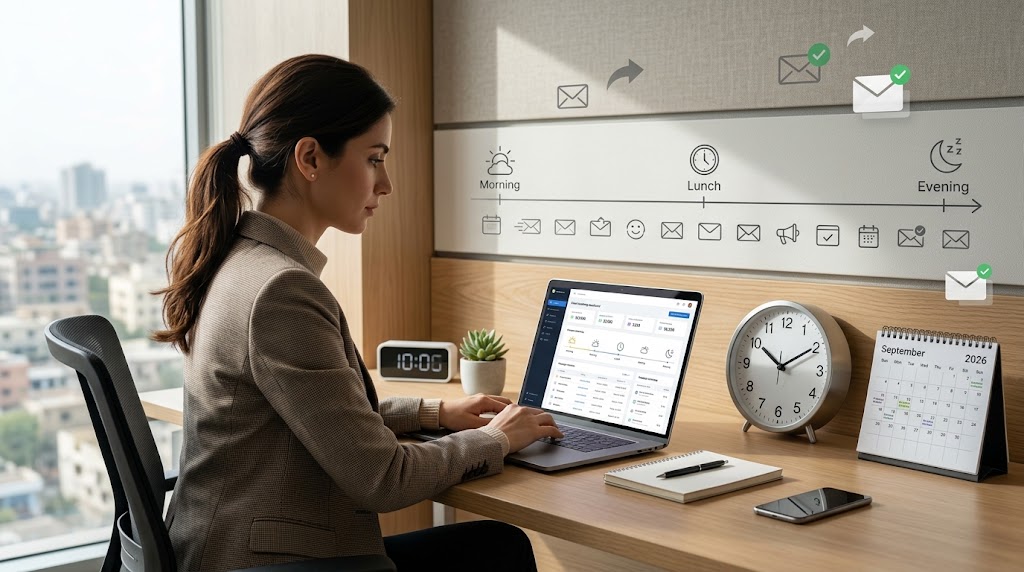
When is the best time to send a marketing email? It is one of the most common questions in email marketing, and the answer is more nuanced than simply choosing a day and pressing send.
Research consistently shows that some days and time windows can produce stronger email engagement than others. For example, recent aggregate data from more than 700 million marketing emails found Tuesday had the highest median open rate among the days analyzed. However, the difference between the best and worst day was relatively small compared with the difference between an individual subscriber's best and worst send times.
That means the best email send time is not necessarily the same for every business, industry, or subscriber.
A strong starting point is to test Tuesday through Thursday during the recipient's local morning hours, then use your own email analytics to identify when your audience is most likely to open, click, and convert.
In this guide, you'll learn the best time to send marketing emails, the best days to send emails, how timing changes for B2B and B2C audiences, and how to find the ideal send time for your own subscribers.
What Is the Best Time to Send a Marketing Email?
For many businesses, weekday mornings are a strong starting point for email campaigns, particularly around the time people begin their workday and check their inboxes.
Mailchimp's send-time optimization data identifies Tuesday, Wednesday, and Thursday as commonly strong days, with 10 AM in the recipient's local time zone appearing as a strong overall newsletter send time. Mailchimp also emphasizes that there is no single day that wins for every audience.
A practical starting schedule is:
- Tuesday: 9 AM–11 AM
- Wednesday: 9 AM–11 AM
- Thursday: 9 AM–11 AM
These are not universal rules. Your subscribers may respond better in the afternoon, evening, or even on weekends depending on their industry, location, lifestyle, and relationship with your brand.
The goal should therefore be to use general benchmarks as a starting hypothesis, not as a permanent rule.
Best Days to Send Marketing Emails
Tuesday: A Strong Starting Point
Tuesday is often considered one of the best days to send marketing emails.
Recent analysis of more than 700 million marketing emails found Tuesday had a median open rate of 22.4% and a median click rate of 2.9%, slightly ahead of Thursday and Wednesday in the same dataset.
Tuesday can work particularly well for professional audiences because subscribers have moved beyond the Monday rush while still being actively engaged with their workweek.
Wednesday: Another Strong Option
Wednesday is another useful day to test.
Midweek emails can reach subscribers after they have settled into their weekly routines. This can make Wednesday a good option for newsletters, educational content, product updates, and B2B campaigns.
Rather than assuming Wednesday is automatically better than Tuesday, compare both days using your own email marketing analytics.
Thursday: Good for Campaigns and Promotions
Thursday can also be a strong email marketing day, especially when your campaign is designed to encourage action before the weekend.
For example, ecommerce businesses may test Thursday campaigns for weekend promotions, product launches, or limited-time offers.
The best choice ultimately depends on your audience and campaign objective.
Monday and Friday: Test Carefully
Monday can be challenging because inboxes are often crowded after the weekend. Friday can also behave differently because subscribers may be less focused on work as the weekend approaches.
That does not mean you should never send on Monday or Friday.
If your audience responds well to these days, your own data should take priority over general benchmarks.
Saturday and Sunday: Audience Matters More
Weekend email marketing can work extremely well for certain businesses, including ecommerce, entertainment, travel, restaurants, hobbies, and consumer services.
However, a professional B2B newsletter may perform differently when sent on Saturday morning.
The key question is not simply "What is the best day to send an email?"
It is:
"When is my audience most likely to have the time and motivation to act on this email?"
Is 10 AM the Best Time to Send an Email?
10 AM is a strong starting point, but it is not automatically the best time for every email list.
Mailchimp's broader send-time analysis identifies 10 AM in the recipient's own time zone as a strong overall time for newsletters.
However, sending every campaign at exactly 10 AM without testing can leave opportunities on the table.
For example:
- A B2B audience may engage during the workday.
- An ecommerce audience may browse products after work.
- A restaurant audience may respond around meal-planning hours.
- A newsletter audience may read content during a morning routine.
- An international audience may be distributed across several time zones.
Instead of asking whether 10 AM is universally optimal, use it as your control time and compare it against other time windows.
Best Time to Send B2B Marketing Emails
For B2B email marketing, start by testing Tuesday through Thursday during business hours.
A useful initial schedule might be:
- Tuesday at 9 AM
- Wednesday at 10 AM
- Thursday at 11 AM
B2B subscribers may be more likely to check work email during their working hours, but industry and job role can change this significantly.
For example, an agency owner may check email throughout the day, while a sales professional may have more time to engage between meetings.
This is where email segmentation becomes valuable. Instead of sending every subscriber the same campaign at the same time, segment your audience according to characteristics such as industry, location, engagement level, or customer stage.
MailSnappy's segmentation tools can support a more targeted approach to audience management.
Best Time to Send B2C and Ecommerce Marketing Emails
B2C email marketing can have a wider range of effective send times.
Consumers may check email:
- Before work
- During lunch
- After work
- In the evening
- During weekend shopping periods
For ecommerce businesses, the best time to send a promotional email may depend more on when customers shop than when they typically read work-related emails.
For example, a weekend sale could be promoted on Thursday or Friday to build awareness before the offer starts.
A flash sale may require a different strategy entirely because the campaign's timing needs to match the promotion's start and end times.
Using an email marketing platform with scheduling capabilities makes it easier to plan these campaigns in advance.
Best Time to Send a Newsletter
For newsletters, consistency can be just as important as finding the perfect hour.
A good starting point is:
Tuesday, Wednesday, or Thursday at around 10 AM in the recipient's local time zone.
Mailchimp's research specifically identifies 10 AM in recipients' local time zones as a strong overall newsletter send time.
However, newsletter readers may develop habits around your publishing schedule.
If your audience knows that your newsletter arrives every Wednesday morning, that consistency can become part of their routine.
Therefore, don't change your newsletter schedule every week simply because another time looks slightly better in a general benchmark.
Test deliberately, measure the results, and give each variation enough time to produce meaningful data.
Best Time to Send Promotional Emails
Promotional emails require more strategic timing than ordinary newsletters.
For a promotion, consider the entire customer journey:
Announcement → Reminder → Last Chance
For example:
- Tuesday morning: Announce the promotion
- Thursday morning: Reminder
- Final day: Last-chance email
The exact schedule should depend on the length and urgency of your offer.
For a 24-hour sale, waiting several days between emails obviously would not make sense.
MailSnappy's email templates can help marketers create campaigns for promotions, sales, product announcements, and other marketing occasions.
Does Email Send Time Really Matter?
Yes, but send time is only one part of email performance.
Your results also depend on:
- Subject line
- Email content
- Offer
- Audience quality
- Personalization
- Segmentation
- Device experience
- Sender reputation
- Frequency
- Call to action
- Landing page
- Customer intent
Campaign Monitor's research on email engagement suggests that subscriber behavior and engagement patterns matter alongside send timing. This reinforces the idea that marketers should avoid obsessing over one exact sending hour while overlooking content quality, relevance, and audience behavior.
Recent data from Seventh Sense's email timing research makes the same point from another angle. The difference between the best and worst days can be relatively small at an aggregate level, while individual subscribers may show much larger differences between their own best and worst engagement times.
So don't spend all your effort finding a magical send time while ignoring your email strategy.
How to Find Your Audience's Best Email Send Time
The most reliable way to determine when to send marketing emails is to analyze your own audience.
1. Start With a Reasonable Benchmark
Begin with Tuesday, Wednesday, or Thursday around 9–11 AM in the recipient's local time.
This gives you a baseline.
2. Test Different Days
Compare:
- Tuesday
- Wednesday
- Thursday
- Monday
- Friday
Keep other major variables as consistent as possible.
3. Test Different Times
After identifying promising days, test different time windows.
For example:
- 9 AM
- 10 AM
- 12 PM
- 2 PM
- 6 PM
Don't change the day, time, subject line, offer, and audience simultaneously. Otherwise, you won't know what caused the performance difference.
4. Measure More Than Open Rate
Open rate is useful, but it shouldn't be your only metric.
Track:
- Click-through rate
- Conversion rate
- Revenue
- Unsubscribe rate
- Bounce rate
- Engagement
- Website activity
For campaigns designed to generate sales, a slightly lower open rate can still be better if it produces significantly more clicks and purchases.
Your email marketing analytics can help you evaluate campaign performance beyond simply looking at how many people opened an email.
5. Segment Your Audience
Different subscribers may have different schedules.
For example, customers in New York may engage at a different local time than customers in California or London.
Similarly, highly engaged subscribers may behave differently from subscribers who rarely open your emails.
Use audience segmentation to test send times across meaningful subscriber groups.
Why Time Zones Matter When Sending Marketing Emails
If your audience is spread across multiple countries or regions, sending everyone an email at the same clock time can create a poor experience.
For example, a campaign scheduled for 9 AM in New York would reach a subscriber on the West Coast much earlier if the same account-level time is used.
Email platforms can address this by scheduling messages according to the recipient's local time zone.
Mailchimp's Timewarp feature can deliver scheduled emails according to each subscriber's local time zone, helping marketers avoid sending campaigns at inconvenient hours for subscribers in different regions.
Campaign Monitor similarly offers recipient-local-time scheduling and individual optimal-time delivery based on subscriber engagement.
If your audience is international, consider time-zone segmentation before deciding on a single global send time.
Should You Send Emails Based on Each Subscriber's Behavior?
If your email marketing software supports it, individual send-time optimization can be more powerful than using one universal time.
HubSpot's send-time optimization feature uses recent engagement signals such as opens and clicks to help determine better sending times for individual contacts. Its optimization can use engagement data from the previous 90 days.
This approach recognizes an important reality:
Your subscribers don't all use their inboxes at the same time.
One person may regularly check email at 8 AM. Another may be more active at 2 PM. A third may open promotional emails after dinner.
The more engagement data you collect, the more accurately you can move from generic benchmarks toward audience-specific timing.
How Email Automation Can Improve Send Timing
Manual scheduling works for individual campaigns, but automation can make timing more scalable.
For example, you can create automated workflows that send:
- Welcome emails after signup
- Abandoned-cart reminders after inactivity
- Follow-up emails after clicks
- Product recommendations based on behavior
- Re-engagement emails after inactivity
- Post-purchase messages
Instead of asking, "What is the best time to send every email?" you can sometimes design a system where the subscriber's behavior determines when the message is triggered.
MailSnappy's email automation software is designed around automated email workflows and campaign management.
Common Email Timing Mistakes to Avoid
Sending Every Email at the Same Time
Just because Tuesday at 10 AM worked once doesn't mean it will always be your best option.
Continue testing as your audience changes.
Ignoring Time Zones
A 10 AM send in one location can become an inconvenient early-morning or overnight email somewhere else.
Always consider where your subscribers are located.
Focusing Only on Open Rates
Opens don't necessarily equal business results.
A campaign with fewer opens but more purchases can be the better campaign.
Testing Too Many Variables at Once
If you change the subject line, design, audience, offer, day, and time simultaneously, you cannot confidently identify what improved the campaign.
Test one major variable at a time whenever practical.
Sending Based Only on Generic Studies
Industry benchmarks are useful starting points, but they don't know your subscribers.
Your own historical performance should eventually become more important than generic recommendations.
Ignoring Email Quality
Even perfect timing cannot save a poorly written email.
Your message still needs a relevant offer, compelling subject line, clear value, readable design, and strong call to action.
A Simple Email Send-Time Testing Strategy
If you're not sure where to start, use this four-week test.
Week 1: Tuesday at 10 AM
Week 2: Wednesday at 10 AM
Week 3: Thursday at 10 AM
Week 4: Test your strongest day at 2 PM
Compare the campaigns using the same primary audience and similar campaign objectives.
After the first round, continue testing around the strongest-performing window.
For a more structured process, use your email campaign software to plan, schedule, and evaluate campaigns.
The Best Time to Send a Marketing Email: Quick Answer
If you need a simple starting point, send your marketing email on Tuesday, Wednesday, or Thursday around 9–11 AM in the recipient's local time zone.
For newsletters, 10 AM local time is a particularly useful benchmark because Mailchimp's large-scale data identifies it as a strong overall send time.
But don't stop there.
The best long-term strategy is to test different days and times, segment your audience, account for time zones, and use your own engagement data to identify when subscribers are most responsive.
The goal isn't to discover a universal perfect hour.
The goal is to discover the best time for your audience.
Frequently Asked Questions About Email Send Times
What is the best time to send a marketing email?
A good starting point is Tuesday through Thursday between 9 AM and 11 AM in the recipient's local time zone. Around 10 AM is a commonly cited benchmark for newsletters, but your audience's behavior should ultimately determine your ideal send time.
What is the best day to send marketing emails?
Tuesday, Wednesday, and Thursday are commonly strong days to test. Recent 2026 aggregate data found Tuesday had the highest median open and click rates in the analyzed dataset, although the difference between days was relatively small.
Is 10 AM a good time to send an email?
Yes. 10 AM is a strong starting point, particularly for newsletters and general marketing emails. However, it should be treated as a benchmark rather than a universal rule.
Is morning or afternoon better for email marketing?
Morning is a strong starting point for many professional and newsletter audiences, while afternoon or evening can perform well for some B2C and ecommerce audiences. Testing both is the best way to determine what works for your subscribers.
Should I send emails based on the recipient's time zone?
Yes, especially if your subscribers are spread across multiple regions. Sending according to each recipient's local time can prevent some subscribers from receiving your campaign at inconvenient hours.
Does the best email send time vary by industry?
Yes. B2B, ecommerce, education, entertainment, travel, and other industries can have different subscriber behaviors. The best time to send a marketing email depends on when your specific audience is available and willing to engage.
How can I find the best time to send emails to my audience?
Start with benchmark times, then test different days and time windows while monitoring clicks, conversions, revenue, and engagement. Over time, use your own campaign data to establish a personalized sending schedule.
Should I prioritize send time or email content?
Both matter, but don't over-optimize timing at the expense of content. A relevant email with a strong offer, useful content, effective subject line, and clear call to action can outperform a perfectly timed but poorly designed campaign.
Final Takeaway
There is no single best time to send a marketing email that works for every business.
Tuesday through Thursday around the morning hours is a sensible starting point, and 10 AM in the recipient's local time zone is a useful benchmark. But the most effective email marketers don't rely on generic timing advice forever.
They test.
They segment.
They analyze engagement.
They account for time zones.
And they use subscriber behavior to improve future campaigns.
When you combine smart timing with strong content, personalization, segmentation, automation, and consistent measurement, your email campaigns have a much better chance of turning inbox attention into meaningful engagement and conversions.