
Mailchimp Alternatives for Small Business: 8 Best Options in 2026
Looking for a better Mailchimp alternative for your small business? Explore 8 of the best email marketing platforms in 2026, with options for automation, templates, contact management, analytics, and affordable pricing.
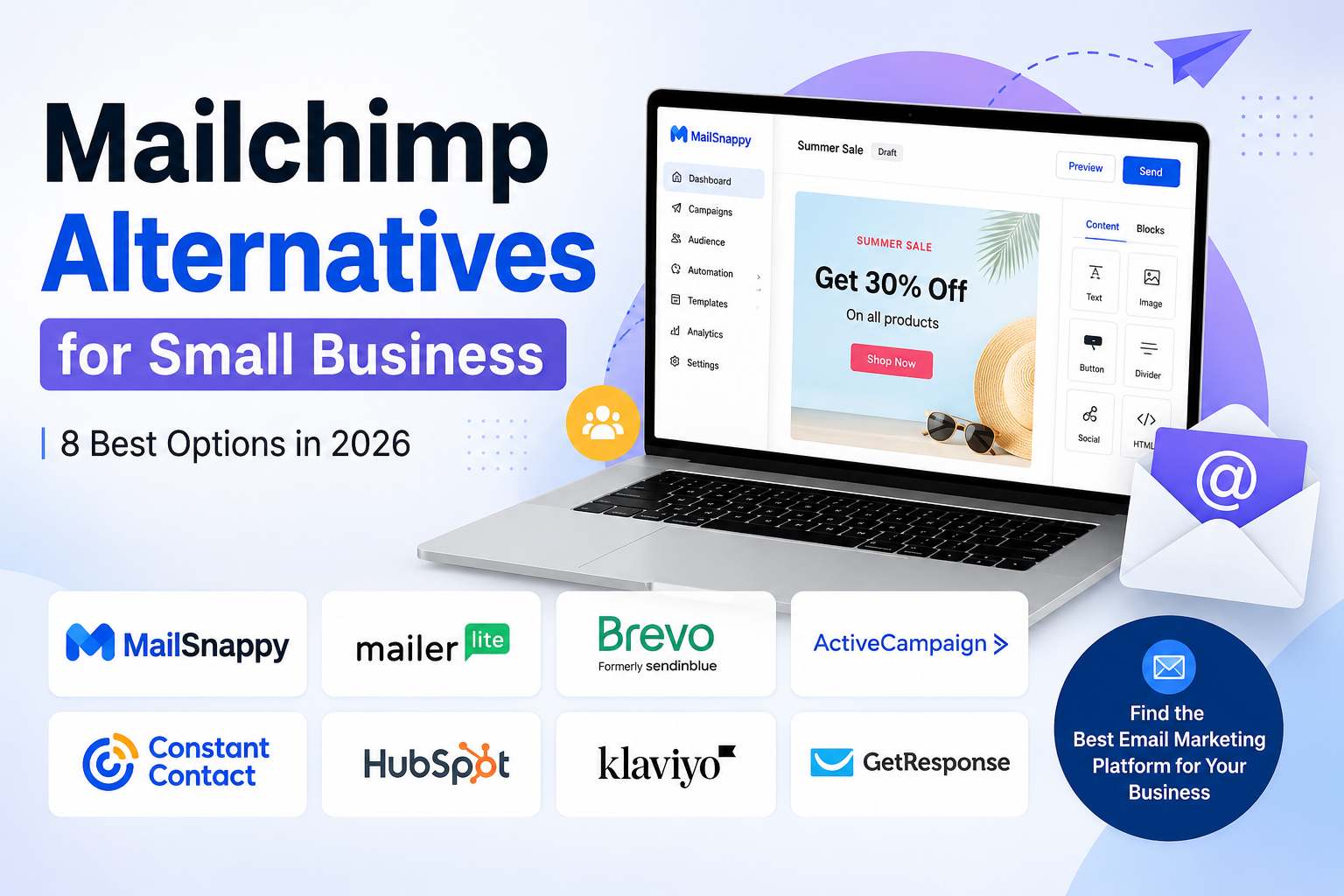
Finding the right email marketing platform can be difficult when you run a small business. You need a tool that is easy to use, affordable, reliable, and flexible enough to grow with your audience.
While Mailchimp is one of the most recognized names in email marketing, it is not necessarily the best choice for every small business. Pricing, contact limits, automation features, and the overall complexity of a platform can make a big difference when you are working with a limited marketing budget.
That is why many businesses are looking for Mailchimp alternatives for small business that offer better flexibility, simpler tools, or pricing that fits their needs.
In this guide, we compare eight of the best Mailchimp alternatives in 2026, including MailSnappy, MailerLite, Brevo, ActiveCampaign, Constant Contact, HubSpot, Klaviyo, and GetResponse.
Why Look for Mailchimp Alternatives for Small Business?
Mailchimp can be a useful email marketing platform, but its free and paid plans may not be ideal for every small business.
For example, Mailchimp's current Free plan supports up to 250 contacts and 500 email sends per month, along with limited features and templates. Businesses that need more contacts, sending capacity, automation, or advanced functionality may need to move to a paid plan. Mailchimp's official pricing information provides the latest details on its plans and limits.
For a small business, these costs can become important as the email list grows.
Some businesses may also want more flexible contact management, while others may prioritize automation, ecommerce integrations, CRM functionality, or SMS marketing.
The good news is that there are plenty of Mailchimp alternatives available in 2026. The challenge is finding one that actually matches your business requirements.
What Should Small Businesses Look for in Email Marketing Software?
Before choosing one of the best Mailchimp alternatives, consider the features that matter most to your business.
Affordable Pricing
Small businesses usually have limited marketing budgets, so pricing should be one of the first things you compare.
Do not only look at the starting price. Check how pricing changes as your subscriber list grows and whether important features are restricted to higher plans.
Contact Management
Your email marketing platform should make it easy to import, organize, and manage subscribers.
Pay particular attention to contact limits. Some platforms calculate pricing based on the number of contacts stored, while others use different pricing models.
Free Email Templates
Professional email design should not require a graphic designer or coding knowledge.
Free, customizable templates can help small businesses create newsletters and promotional campaigns faster.
Email Automation
Automation is another important feature to consider. A good email automation platform can help you automatically send welcome emails, follow-ups, reminders, and other messages based on subscriber actions.
Segmentation
Not every subscriber should receive the same message.
With email segmentation tools, businesses can divide their audience based on interests, behavior, location, purchase history, or engagement.
Analytics and Reporting
Email marketing is much more effective when you can measure results.
Features such as open rates, click rates, campaign performance, and subscriber engagement help you understand what is working and what needs improvement.
You can learn more about these capabilities through MailSnappy's email analytics features.
Scalability
The right email marketing software for small business should work for you today and continue to make sense as your business grows.
8 Best Mailchimp Alternatives for Small Business in 2026
1. MailSnappy — Best Mailchimp Alternative for Small Businesses
MailSnappy is designed for businesses that want straightforward email marketing tools without unnecessary complexity.
As a Mailchimp alternative for small business, MailSnappy provides tools for creating campaigns, managing audiences, building emails, automating communication, segmenting subscribers, and measuring campaign performance.
One of the biggest advantages is its contact flexibility. MailSnappy allows users to upload unlimited email contacts, which can be useful for businesses building and maintaining a growing customer database.
MailSnappy also provides completely free email templates, allowing businesses to create professional campaigns without paying extra for access to templates.
Another useful feature for smaller businesses is that 50 emails per campaign are free each month. This provides an opportunity to start using email marketing without immediately committing to a larger marketing budget.
Businesses can explore the platform's email marketing software to learn more about its campaign and audience management capabilities.
Key MailSnappy features include:
- Unlimited email contacts can be uploaded
- Completely free email templates
- 50 emails per campaign are free each month
- Email campaign management
- Audience management
- Email segmentation
- Email automation
- Analytics and reporting
- Email builder
- Automation builder
Businesses can also explore MailSnappy's free email templates when looking for ready-to-use campaign designs.
For businesses that want to grow an email list without worrying about a traditional contact-upload restriction, MailSnappy can be an appealing alternative.
Best for: Small businesses, startups, entrepreneurs, and businesses looking for a simple and flexible Mailchimp alternative.
2. MailerLite — Best for Beginners and Newsletters
MailerLite is one of the popular Mailchimp alternatives for small business, particularly among beginners, bloggers, creators, and businesses that primarily send newsletters.
The platform focuses on making email marketing relatively simple, with tools for newsletters, landing pages, forms, automation, and audience management.
MailerLite's current free plan supports up to 500 subscribers and includes a limited monthly sending allowance. The platform also provides campaign creation and other basic email marketing features. Businesses should check MailerLite's official pricing page for the latest limits and plan details.
MailerLite can be a good choice if your business wants an easy-to-understand platform and does not need highly advanced automation.
Best for: Beginners, newsletters, bloggers, creators, and small businesses starting with email marketing.
3. Brevo — Best for Email and SMS Marketing
Brevo is another popular option among businesses searching for Mailchimp alternatives.
One of its main advantages is that it combines email marketing with SMS and other customer communication tools.
Brevo's free plan allows businesses to store a large number of contacts, although daily email sending limits apply. The platform also provides email templates, campaign creation, basic automation, and reporting.
You can check Brevo's official pricing for the latest plan limits.
For a business that wants to communicate with customers through both email and SMS, Brevo can be a strong alternative.
Best for: Small businesses that want email and SMS marketing in one platform.
4. ActiveCampaign — Best for Advanced Email Automation
ActiveCampaign is particularly well known for marketing automation and customer journeys.
Rather than focusing only on newsletters, the platform allows businesses to create automated workflows based on customer behavior and engagement.
For example, businesses can build sequences for new subscribers, leads, customers, and inactive contacts.
This makes ActiveCampaign a good choice for companies that have moved beyond basic email campaigns and need more sophisticated automation.
However, its advanced functionality may be more than a very small business needs when starting out.
Best for: Growing businesses that need advanced email automation and customer journeys.
5. Constant Contact — Best for Local Small Businesses
Constant Contact has been serving small businesses and organizations with email marketing tools for many years.
Its platform provides email campaigns, templates, automation, reporting, signup tools, and integrations.
Businesses can review Constant Contact's official pricing to compare its current plans.
The platform can be particularly useful for local businesses, nonprofits, events, and organizations that want to combine email marketing with other digital marketing activities.
Best for: Local businesses, nonprofits, events, and organizations.
6. HubSpot — Best for CRM and Marketing
HubSpot takes a broader approach to digital marketing by combining marketing tools with customer relationship management.
Its ecosystem includes CRM functionality, forms, landing pages, lead management, marketing automation, and reporting.
Businesses can explore HubSpot's free marketing tools to see what is available without an immediate paid subscription.
HubSpot can be a strong choice for a small business that wants its customer data and marketing activities connected through one platform.
However, it can be more complex than necessary if you only need to send newsletters and promotional emails.
Best for: Small businesses that want CRM and marketing tools together.
7. Klaviyo — Best for Ecommerce Businesses
Klaviyo is particularly popular among ecommerce businesses because of its focus on customer data, segmentation, and behavioral marketing.
An online store can use customer activity to create targeted email campaigns and automated messages.
For example, ecommerce businesses can create campaigns based on purchases, browsing activity, customer engagement, or other available data.
Klaviyo offers a free option for smaller businesses, although contact and sending limits apply. You can check Klaviyo's official pricing for the latest information.
The platform can become especially useful when ecommerce businesses need detailed customer segmentation and advanced automation.
Best for: Ecommerce stores, online retailers, and brands focused on customer behavior.
8. GetResponse — Best for Email Marketing and Funnels
GetResponse combines email marketing with landing pages, automation, lead generation, and conversion-focused tools.
Its platform can be useful for businesses that want to create a complete marketing funnel rather than simply send newsletters.
The free plan currently provides limited access to email marketing features, while paid plans add more advanced functionality. Businesses can check GetResponse's official pricing for current plan details.
GetResponse is particularly useful for businesses that want to connect email campaigns with landing pages and lead-generation activities.
Best for: Small businesses that want email marketing, landing pages, and marketing funnels.
Mailchimp vs Alternatives: Which Is Better for Small Business?
Mailchimp remains a well-known email marketing platform, but it is not automatically the best solution for every small business.
The right choice depends on what you need from your email marketing software.
If you want a simple platform with flexible contact management, MailSnappy is worth considering.
If your priority is simple newsletters, MailerLite may be a better fit.
If you want email and SMS marketing together, Brevo is worth looking at.
For advanced automation, ActiveCampaign offers more sophisticated workflows.
HubSpot makes more sense when CRM functionality is important, while Klaviyo is particularly suitable for ecommerce businesses.
GetResponse is a good option if landing pages and marketing funnels are part of your strategy.
You can also compare different solutions through MailSnappy's Mailchimp alternative page.
How to Choose the Best Mailchimp Alternative for Your Small Business
Choosing an email marketing platform becomes easier when you start with your actual business requirements.
1. Consider Your Audience Size
Think about how many contacts you currently have and how quickly your list is growing.
A platform that works well with 500 subscribers may not be the best option once you have 10,000 subscribers.
2. Think About Your Campaign Frequency
Do you send one newsletter every month, or do you plan to run several campaigns every week?
Your sending frequency can affect which pricing model provides the best value.
3. Decide How Much Automation You Need
If you only need newsletters, basic campaign functionality may be enough.
If you want welcome sequences, follow-ups, customer journeys, and behavioral campaigns, look for a platform with a proper automation builder.
4. Look at Audience Growth Tools
Growing your email list is just as important as sending emails.
Features such as signup forms, audience management, and lead-generation tools can help turn website visitors into subscribers.
You can explore MailSnappy's audience growth tools if list building is one of your priorities.
5. Check Templates and Email Design
A good email builder can save hours of work.
Small businesses should look for a platform that offers professional templates and an easy-to-use email builder.
6. Compare Analytics
Your email marketing strategy should improve over time.
Choose software that provides useful campaign data so you can understand engagement and make better decisions.
7. Consider Long-Term Costs
Do not choose an email marketing platform based only on its free plan.
Compare what you will pay when your contact list and email volume grow. A slightly different pricing model can make a significant difference over several years.
Which Mailchimp Alternative Is Best for Small Business?
There is no single best Mailchimp alternative for small business because every company has different needs.
MailerLite is a practical option for beginners and newsletter-focused businesses. Brevo is useful for businesses that want email and SMS communication. ActiveCampaign is better suited to advanced automation, while Constant Contact can work well for local businesses and organizations.
HubSpot is a strong option for businesses that want CRM and marketing together. Klaviyo is particularly useful for ecommerce brands, and GetResponse is a good choice for businesses that want email marketing combined with landing pages and funnels.
For small businesses looking for unlimited email contact uploads, completely free email templates, and 50 campaign emails per month for free, MailSnappy is a strong option to consider.
You can review its email marketing platform, pricing, and features before deciding whether it fits your marketing strategy.
The best email marketing platform is ultimately the one that gives your business the features it needs without adding unnecessary cost or complexity.